
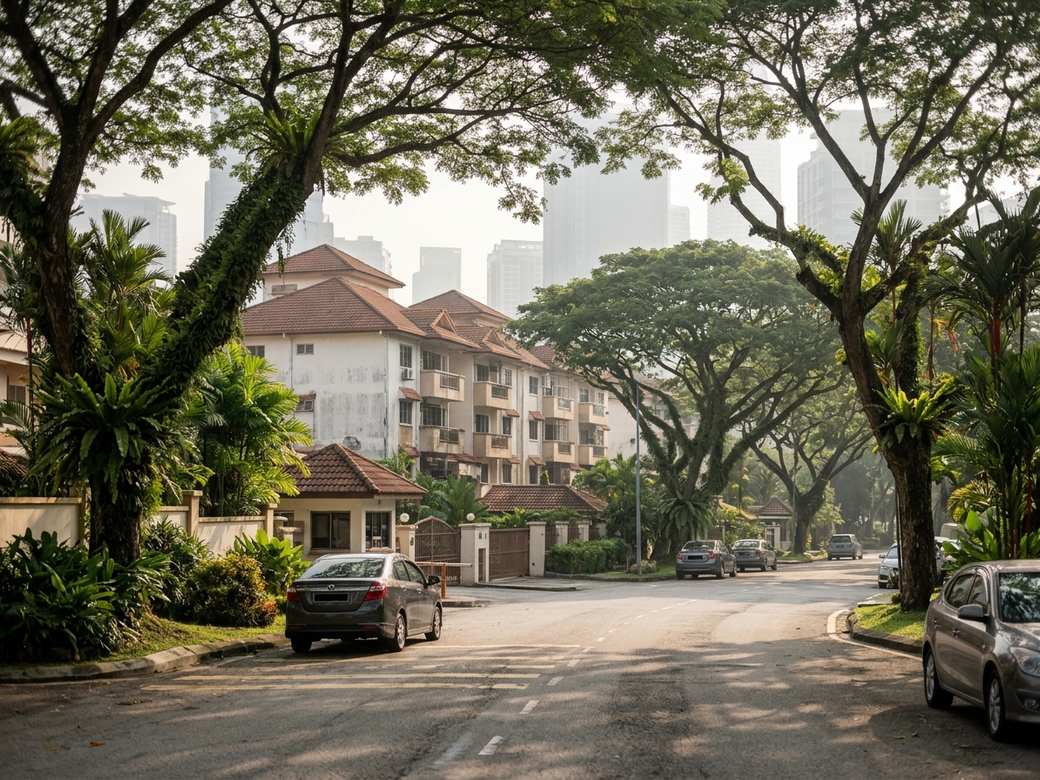
Bangsar itself: landed streets first, towers afterwards
Bangsar began as a group of housing estates. Bangsar Park was the first, laid out at the end of the 1960s with terraced and semi-detached houses, and Bangsar Baru followed in the mid-1970s with its houses and the shop district now known for the Telawi streets. Bukit Bandaraya, with terraces of two and three storeys, Lucky Garden, which has single-storey terraces, Taman SA and Bangsar Utama stand around them.
Condominiums arrived from the mid-1980s. Sri Wangsaria on Jalan Ara belongs to that first group, and more were built along Jalan Maarof and the roads off it through the 1990s. A later generation dates from about 2009 onwards, and building continues. One neighbourhood therefore holds homes of three distinct ages, and the age of yours is the most useful thing to mention after the fault itself.
In a terrace house of the 1970s the likely work is the conversion of fluorescent fittings in the kitchen and the porch, the exchange of a ceiling fan that has turned on the same hook for decades, and attention to timber doors that have swollen until they bind in the frame. The page on light fittings and downlights explains when the tube alone can be changed and when the whole fitting should go.
An owner-occupier in a block of the 1980s or 1990s is more likely to be troubled by water: a mixer that drips however firmly it is closed, or a cistern that runs on after it has filled. Whether such a fitting can be repaired depends on whether parts of its pattern are still made, a question taken up under taps, cisterns and leaks.
A tenant in one of the newer towers usually has nothing broken at all, only bare walls and uncovered windows. Mirrors, pictures, a television and curtains are the work there, and the questions concern what the wall is made of. That is the subject of mounting and curtains.
The Telawi streets are a grid of two and three-storey shoplots, well over a hundred of them, built with Bangsar Baru. Clinics, salons, professional offices, cafés and restaurants occupy most of them now. An office on an upper floor there gathers a list much like a household's, a pantry tap, a door closer, a few failed tubes, and that work is described under small jobs for offices and shops.
One practical matter is common to them all. Parking in Bangsar is short and Jalan Maarof is congested for much of the day, which is why a visit here is fixed by appointment for an agreed hour.
The five districts around Bangsar
Each neighbouring district was built in its own period, and each has a fuller page of its own.
Bangsar South
The residential and office towers of the Kerinchi redevelopment stand beside apartments a generation older, Vista Angkasa among them. In a recent tower the first owner is usually fitting lights, fans and curtain tracks to points left bare at handover. In the older blocks the work is the replacement of what has worn.
Damansara Heights
This was a housing scheme begun in about 1971, with landed plots and flats, and it is known today for bungalows and semi-detached houses, the terraces of Medan Damansara and the shop-offices of Plaza Damansara. Serviced residences have been added since the 2010s, including those above the Pavilion Damansara Heights mall. A large older house tends to produce a long list that is best assessed in one piece. A new residence produces the opposite: every fitting put up for the first time.
Mid Valley and KL Eco City
Here the homes are serviced residences built above mall and office podiums, such as Northpoint Residences of the mid-2000s, with KL Eco City joined to The Gardens Mall by a bridge. Office suites stand in the same developments. The units are compact and many are let. Mounting in a small room, where there are few walls to choose between, is the characteristic job.
KL Sentral and Brickfields
Towers have risen around the station since the early 2000s, Suasana Sentral Condominium among the earliest, and they stand beside the much older streets of Brickfields, where two-storey shophouses line Jalan Tun Sambanthan. In a tower some twenty years old, taps, heaters and lamps may well come due for replacement close together. In the older blocks the walls are often brick, which changes how things are hung.
Pantai
Low-rise blocks have stood on the hill at Pantai Hillpark since the early 1990s. The condominiums of Bukit Pantai, which stand among houses, began to arrive at the end of that decade, and the towers of Pantai Sentral Park are recent. On the hill an ageing storage heater is a likely enquiry, and whether the block has a lift matters to how its replacement is carried in.
What to say, whichever district you are in
Four details place a job better than a long description does.
- The name of the building and the block or tower, or the road if the place is a house or a row of shops.
- Roughly when it was built, if you know. The decade is enough.
- The floor, and whether a lift serves it.
- Whether you own the place or rent it.
Wiring and work on water-supply pipes are regulated in Malaysia, in all six districts alike. You may ask who is to carry out that part of a job and under what registration, and a job that needs an additional point, a separate circuit or attention at the distribution board is identified before any quote is given. The Get in Touch page carries the enquiry form.
Questions about the districts covered
My home is just outside the six districts named here. May I still enquire?
You may. The six districts are the ones around which the work is arranged, and a home a little beyond one of them is not ruled out on that account. Send the name of the building, the road and a description of the job. The reply says plainly whether it can be taken on.
My Bangsar home is a terrace house, not a condominium. What is different?
Two things. A house on a landed street usually has no management, so there is no strata approval to seek and no register for workmen, only the courtesy owed to the neighbours. And the house is probably older than most of the condominiums, so fittings of several periods may sit side by side.
How do I find out when my building was completed, and why is it asked?
The management office will know, and the sale and purchase papers usually show it. The decade is sufficient. It is asked because the period suggests what kind of pipework, walls and fittings to expect, and so which parts are likely to suit. Earlier owners renovate, however, and a photograph of the fitting always outweighs the date.