
Three surfaces, and why they differ
A wall in a Bangsar home is commonly one of three things. The terrace houses of Bangsar Park, the houses of Bangsar Baru, and the infill walls of the condominiums that followed from the mid-1980s, are commonly clay brick under a coat of cement plaster. The columns, the beams and some of the walls of those condominiums are reinforced concrete. Bathrooms and kitchens are tiled over one or the other. A fixing that is right for the first may be wrong for the second. A room added to a house in a later renovation may be different again, built of lightweight block or of board on a frame, so mention it if the wall sounds hollow.
Plastered brick
Plaster carries no load worth the name. On a brick wall it is a skin, and a plug that expands only within it will pull out under weight. The plug has to sit wholly in the brick, so the hole is drilled deeper and the screw chosen longer than the bracket's packet supposes. Where the bit finds a mortar joint, a plug grips poorly, and the hole is moved.
Concrete
Concrete is the opposite case: hard to enter and very firm once entered. It requires a hammer drill and makes more noise, which matters where the management confines noisy work to set hours. The beam above a window is often concrete, which is why a curtain bracket can be slow to fix.
Tile
A tile is a brittle face laid over one of the walls above, and the fixing must hold in the wall, not in the tile. The glaze is entered slowly with a tile bit and without hammer action. The plug is then seated beyond the back of the tile, so that it expands in the masonry and does not press outwards against the tile.
| Surface | How it is drilled | What carries the load | What to watch for |
|---|---|---|---|
| Plastered brick | Masonry bit, with little hammer action | A plug and screw seated in the brick, past the plaster | Mortar joints; loose or hollow plaster |
| Concrete | Hammer drill | A plug or an expansion anchor in the concrete | Reinforcing steel; the hours allowed for noise |
| Tile over masonry | Tile bit, slowly, no hammer action through the tile | A plug set behind the tile, in the wall itself | Hollow tiles; pipes behind bathroom walls |
| Lightweight partition | According to the board or block | An anchor made for that material, or a fixing into the frame | A heavy item may belong on another wall |
The last row concerns newer towers, where the walls between rooms are often lightweight partitions, and rooms added to a house in a later renovation.
The 300 mm by-law
In a strata building the statutory by-laws forbid drilling, hacking and screw-fixing within 300 mm of concealed pipes and conduits, and they bind tenants as much as owners. The favoured place for a television is above a group of sockets, and the conduits that feed sockets and switches generally run up or down the wall from them. A mirror over a basin hangs close to the pipes that serve the taps. Before a hole is made, the by-law asks for two checks: a detector passed over the wall, and a look at the as-built plans kept at the management office.
Televisions
For a television three facts are needed: its weight, the pattern of mounting holes on its back, and whether the bracket is flat, tilting or carried on an arm. An arm that swings out increases the pull on the upper fixings.
Cables are the other question. Hiding them inside the wall means cutting a channel, which is hacking; in a strata building it needs the management's written approval. Surface trunking is the usual alternative. A socket wanted behind the screen is an addition to the wiring, and wiring is a regulated trade: ask who is to carry out that part and under what registration. A job that needs an additional point, a separate circuit or attention at the distribution board is identified as such before any quote.
Mirrors and pictures, by weight
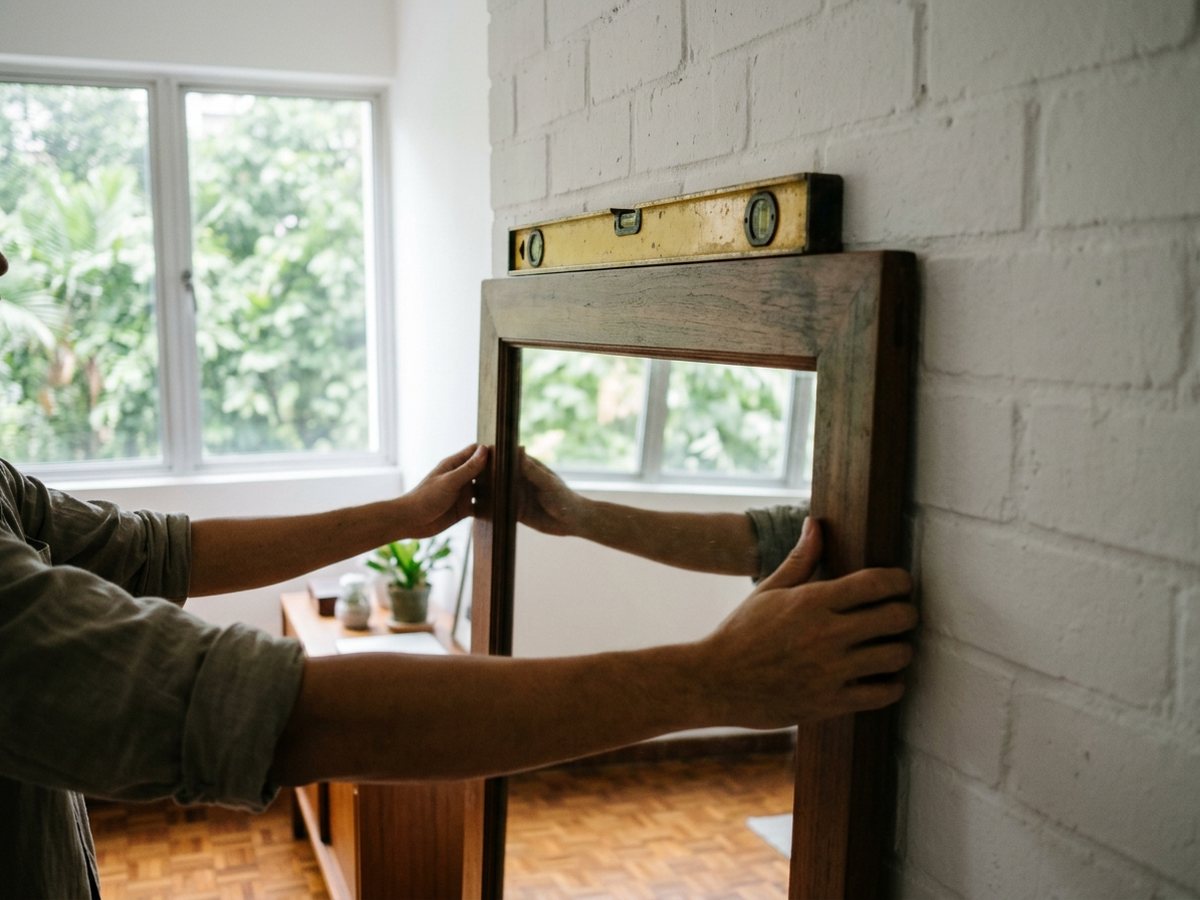
Weight decides the method. A small picture hangs safely from one plug in brick. A large framed mirror wants two fixings, each able to bear the whole weight alone, because the load is seldom shared equally. The fittings on the back of the frame deserve as much attention as the wall: a wire supplied with a heavy mirror is often the weakest part of the arrangement.
Rails, tracks and blinds
A curtain rail rests on brackets fixed to the wall above the window, while a track is more often fixed overhead. A plaster ceiling carries little, so a track there must be screwed into the slab or into a timber behind the plaster. For blinds, measure the width of the opening at the top, the middle and the bottom, since the openings of older buildings are rarely quite square.
What to send, and what moves the cost
- A photograph of the whole wall, taken square on, showing any sockets, switches or taps.
- What the item is, with its size and its weight.
- The building and the floor, or the road if it is a house, and any hours a management sets for drilling.
Cost follows the number of fixings, the hardness of the surface and the height at which the work is done. Boards, screens and shelving for a workplace are covered under small jobs for offices and shops. A light to be hung on the same wall is covered under pendant and wall light fittings. Tenants furnishing a compact unit in Mid Valley and KL Eco City, or a bare one in Bangsar South, should look to the tenancy agreement for what may be fixed to the walls.
Questions about fixing to walls
The wall is brick behind plaster. Does that change how a TV is mounted?
It changes the depth more than the method. Brick holds a television well, provided each plug sits in the brick and not in the plaster over it, so longer plugs and screws are used than those packed with the bracket. State the television's weight and the type of bracket, and send a photograph of the wall.
Can heavy mirrors and artwork be hung on tiled walls without cracking a tile?
Usually, with care over three things. The tile is drilled slowly with a tile bit. The plug is seated behind the tile, so that it grips the wall. Tiles that sound hollow when tapped are poorly bedded and are left alone. On a bathroom wall the pipes come first, and the 300 mm rule may decide where the mirror can go.
Can blinds be fitted inside the window recess?
Often they can. The recess must be deep enough for the headrail to clear handles, stays and any grille, and its top must be something that will hold a screw. Often that is the underside of a concrete beam, firm but slow to drill. Where the recess is shallow or out of square, fixing to the wall above is the better course.