
Small faults arrive in company
A house in Bangsar Park or Lucky Garden, or an apartment in one of the blocks of the 1980s and 1990s, seldom has only one thing wrong with it. The bedroom door catches on its frame, a lever handle droops, the bell at the gate works when it chooses, and the seal round the bath has gone black. None of these is serious, and for that reason each tends to be left. The cause decides whether a fault calls for adjustment or for a new part.
Timber doors that swell and stick
Homes of that period were commonly given timber doors in timber frames, and timber moves. It takes up moisture in humid weather and swells, most of all at an edge that was never painted, such as the foot of a bathroom door. A door also drops. Its weight hangs chiefly on the top hinge, and when the screws there work loose in the frame the whole leaf tilts, rubbing at the top corner on the latch side.
The two causes look alike and are treated differently, so where the door rubs is the first thing to establish. A dropped door is put right at the hinges: the screws are tightened, or the worn holes are plugged and longer screws driven into sound wood. A swollen door is eased with a plane, and the bare edge is sealed again, because unsealed timber only swells further.
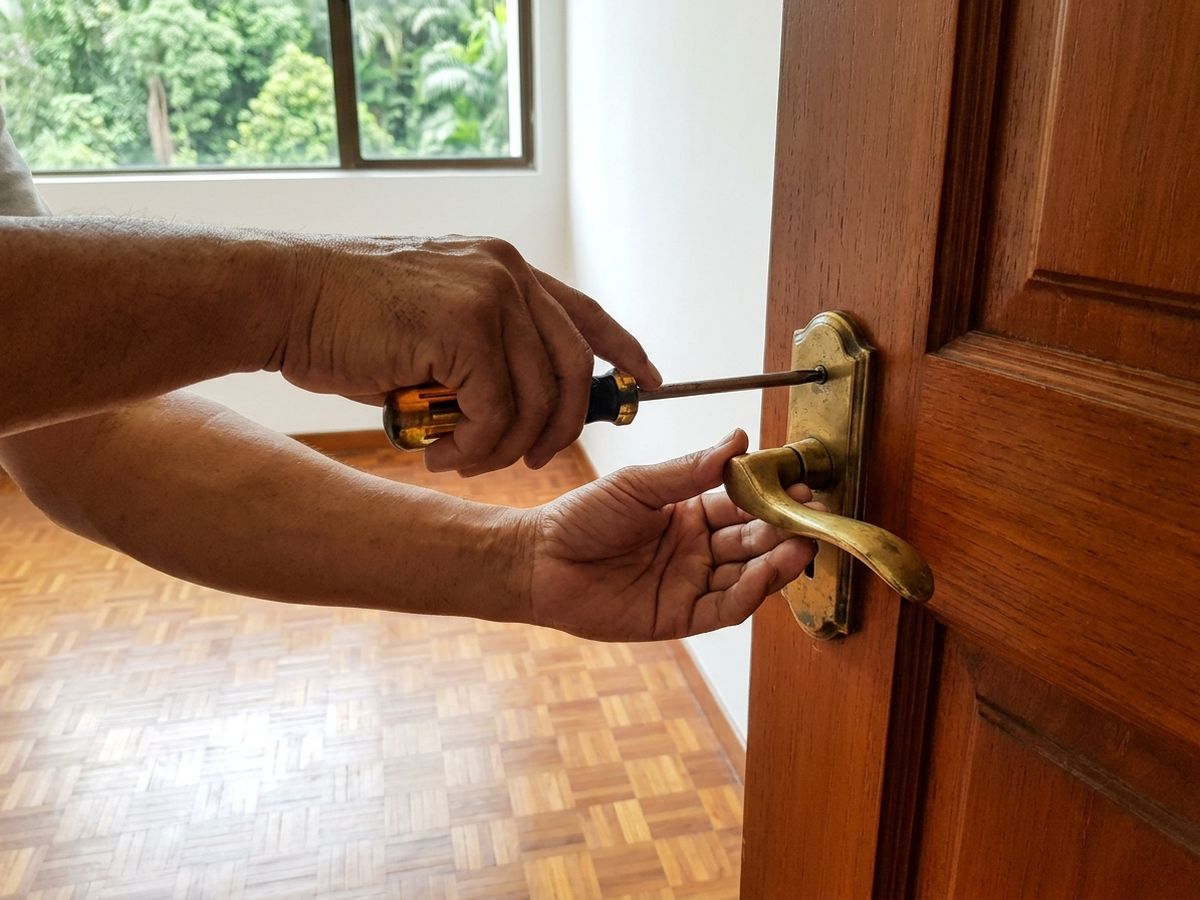
Latches, lever handles and locks
A door that will not latch has usually shifted in relation to its frame, so that the bolt no longer meets the opening in the strike plate. The plate is adjusted to suit. A lever that droops has a tired spring in the handle or the latch.
Where a part must be exchanged, measurements govern. The distance from the edge of the door to the centre of the handle, the thickness of the door and the size of the lock case let into its edge all differ between makes and periods. A photograph of the door edge with a ruler held beside it is the most useful thing to send. A door locked shut with no key is work for a locksmith, and is not undertaken. Sliding doors, window stays and door closers are explained separately under doors and windows.
Door bells and loose switch plates
A wireless bell has a battery in the push and a chime that plugs in or runs on batteries of its own. When it falls silent, the battery or a push spoiled by rain is usually the reason, and a push that stands on a gate post should be one made for outdoor use. A wired bell is part of the home's electrical installation, and a fault in it is assessed as a wiring matter.
A switch plate that moves when pressed may be held by nothing worse than slack screws. Even so, whatever lies behind the plate is wiring, and wiring is a regulated trade in Malaysia. Suruhanjaya Tenaga is the body with which electrical contractors and competent persons register. Ask who is to carry out that part and under what registration. A fault that proves to need an additional point, a separate circuit or attention at the distribution board is identified as such before any quote. A plate that is warm, discoloured or noisy should be switched off at the board.
Cabinet hinges and resealing
Kitchen cabinet doors hang on concealed hinges with adjusting screws, and a door that sits crooked can usually be brought back into line with those alone. When the hinge itself has failed, the new one has to match the old in the way the door overlaps the cabinet.
Sealant round a bath, basin, sink or shower screen blackens and lifts with age. Fresh sealant laid over old does not last, so the old bead is cut out completely, the joint cleaned and dried, and a new bead run and left to cure. A new seal keeps splashed water out of a joint. It is not waterproofing, and it will not stop water that reaches the floor below by another route.
How a list is handled in one visit
List and photograph
Write each fault on a line of its own and attach a photograph of each. Add the building and the floor, or the road if it is a house.
Assessment
The reply goes through the list item by item: what can be adjusted, what needs a part, and what belongs to another trade.
One appointment
A single time is fixed, Monday to Saturday between 9.00 am and 6.00 pm. Parking in Bangsar is short and Jalan Maarof is often congested, which is one reason a list is better served by one planned visit than by several.
Order of work
Dusty work such as planing is done first and sealant last, so that it is not disturbed.
What moves the cost
The cost of a list depends on the number of items, the parts, and how much of it is adjustment as against replacement. Items found to involve wiring or supply pipes are set out separately in the quote, which follows the photographs.
A tap that drips or a cistern that runs on is covered under taps, cisterns and leaks, and a mirror, shelf or rail to be put up under mounting and curtain rails. A long list is to be expected in a large older house, such as those of Damansara Heights.
Questions about small repairs
A door has started to stick or will not latch. Is that a handyman job?
It usually is. Most doors that stick have either swollen along an edge or dropped on a loosened hinge, and most that will not latch have moved out of line with the strike plate. All three are put right with adjustment, a plane or longer screws. Send a photograph of the closed door, and say where it rubs.
Should I look for an electrician in Bangsar for a loose switch or socket?
Begin by describing the fault, with a photograph. Whatever is behind the plate counts as wiring, which is a regulated trade. The reply therefore states what the job involves, and you may ask who is to carry out that part and under what registration. If the fault turns out to need an additional point, a separate circuit or attention at the distribution board, you are told before any quote.
Can a round door knob be exchanged for a lever handle?
Often, though not always neatly. A knob set generally sits in a large round hole through the door, and the lever set chosen must have plates wide enough to cover it. The new latch should match the old in its distance from the door edge, or the door has to be altered. Send a photograph of the door edge before buying.