
The marks an older wall collects
Bangsar's landed streets date from the 1970s and its first condominiums from the mid-1980s, so a home here has usually been arranged several times over, and each arrangement leaves something behind on the walls. There are screw holes where an earlier owner's shelves hung, and scuffs along a corridor at the height of a chair back. On a ceiling beneath a bathroom there may be a brown ring from a leak that was repaired long ago.
The question each raises is how little paint will make it disappear, and the answer is often more paint than the mark itself would suggest.
Why a patch of fresh paint stands out
The paint on a wall is no longer the colour it was on the day it was applied. Light fades it and the years dull its surface, so fresh paint of the very same colour dries a little brighter and cleaner than the wall around it.
Sheen is the second difficulty. Paint dabbed on with a brush dries to a different texture from paint laid with a roller, and daylight falling along a wall from a window picks out that difference even where the colour is right. A patch in the middle of a wall that catches the light therefore tends to be seen as a patch.
A close match needs the original paint, which means its maker, the colour name or code, and the finish. Without those, a colour chosen by eye will be near and never quite the same, and the dependable course is to repaint the wall from corner to corner. A corner is the natural place to stop, because two walls meet the light at different angles and a slight difference between them is not perceived.
Touch-up or the whole wall
| Matter | Touching up | Repainting the whole wall |
|---|---|---|
| Suits | A few small marks on a wall painted fairly recently, or out of direct light | Several repairs on one wall, an older wall, or a wall with no record of its paint |
| Needs | The original paint, or its maker, colour code and finish | A colour chosen to sit with the adjoining walls |
| Risk | The patch dries brighter or flatter than its surroundings | A slight difference from the next wall, seldom noticed across a corner |
| Ends at | The edge of the repair, feathered outwards | The corners, the ceiling line and the skirting |
Holes and hairline cracks
The filling decides the result more than the painting does. An old plug is drawn out or driven below the surface, the hole is cleared of loose plaster and filled, and the filler is left to harden before it is sanded flush with the wall. It is then spot-primed. That last step is easily omitted, and the reason for it is simple: filler is more absorbent than the painted wall around it, so it draws the paint in and shows through an otherwise even coat as a dull patch.
Hairline cracks in plaster are treated in the same manner. A crack that opens again after it has been filled is saying something about the wall behind it, and paint is not the answer. Holes left when a television or a shelf comes down are a familiar case, and putting one up again is covered under mounting and curtain rails.
The stain a leak leaves behind
A water stain is painted only after the leak that caused it has been cured and the wall or ceiling has dried.
Even a dry stain is not painted directly. It is sealed first with a stain-blocking primer, because the brown mark otherwise tends to come back through ordinary wall paint, and a further coat seldom cures it. Mould is washed off and treated before any painting. Where the damp continues, paint will not solve it, and the source is the thing to find. A slow drip beneath a basin or behind a cistern is dealt with under taps, cisterns and leaks. Water arriving from the home above begins with a notice to the management. Painting is not waterproofing.
One wall or one room
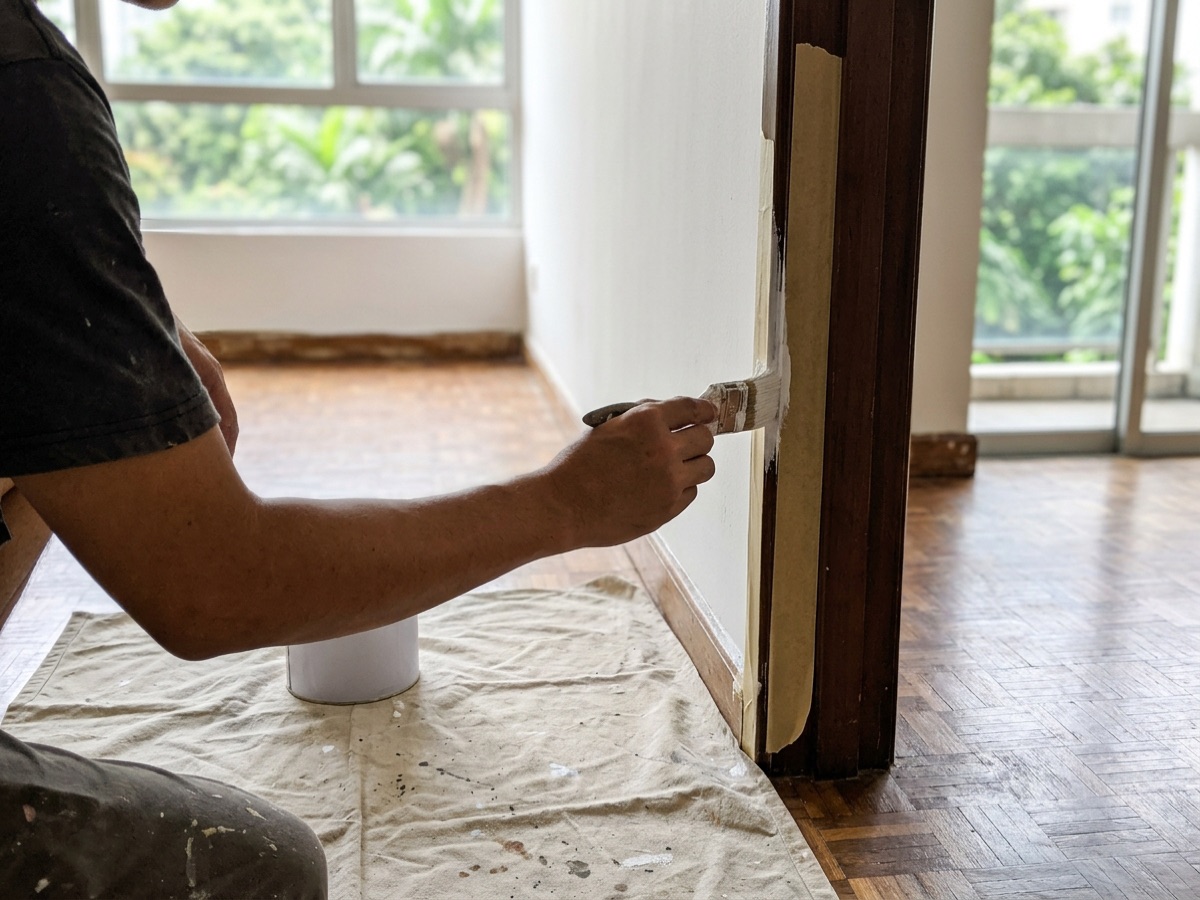
The work extends from touch-ups to a single wall and to a single room. For a room, the furniture is moved to the centre and covered, the floor is covered as well, and the edges are masked: switch plates, skirtings and door frames. In older homes the door frames are often of stained or varnished timber. Wall paint that strays onto such a frame cannot simply be painted over, as it could on a painted one, so the frame is masked and the line where wall meets timber is cut in with a brush.
Water-based emulsion is the usual paint for interior walls, and how long one coat must dry before the next depends on the product and on the weather.
The outside of a building, the repainting of a whole house as a project, and textured or special-effect finishes are not undertaken.
Touching up before moving out
A tenant about to hand a home back may want the picture holes filled and the walls made presentable. What a tenant is obliged to make good is set by the tenancy agreement, and no opinion is offered here on what counts as fair wear. Read the agreement, or ask the landlord, before deciding how much to have done. A shop or an office handed back at the end of a lease raises the same question, taken up under small jobs for offices and shops.
What to send, and what moves the cost
- A close photograph of each mark, and one of the whole wall showing where the light comes from.
- The maker, colour and finish of the paint, if a tin or a record survives.
- Your building or street, and whether you are the owner or a tenant.
The cost is moved by the area to be painted, the number of repairs to fill, whether a stain or mould has to be treated first, the height of the ceiling and the amount of furniture to move and cover. A quote follows the photographs. A long list of marks is likely where rooms are let to one occupant after another, as among the student rentals of Pantai Dalam, described under Pantai.
Questions about painting and touch-up
I still have the original tin. Will a touch-up be invisible?
It is more likely to be, though it cannot be promised. The paint in the tin has not faded as the wall has. It is stirred thoroughly and tried first on a spot that is out of sight. If the dried patch cannot be found from an arm's length in daylight, the remaining marks are touched up. If it can, the wall is repainted, and the tin supplies the colour to buy.
A brown ring has appeared on the bedroom ceiling. Can it simply be painted over?
Not until its cause is known. The ring is the trace of water, and while the source remains active any new paint will stain again. In a strata building, a leak from the floor above is reported to the management office first. Once the leak is cured and the ceiling has dried, the mark is sealed with a stain-blocking primer and the ceiling is then repainted.
Can one wall be painted a different colour from the others in the room?
It can, and the corners make it straightforward, because the new colour ends at a natural line on each side. Two matters are worth settling beforehand. The finish should usually be the same as on the other walls, so that the sheen agrees. The existing colour also counts, since a strong colour usually takes more coats to cover with a pale one.