
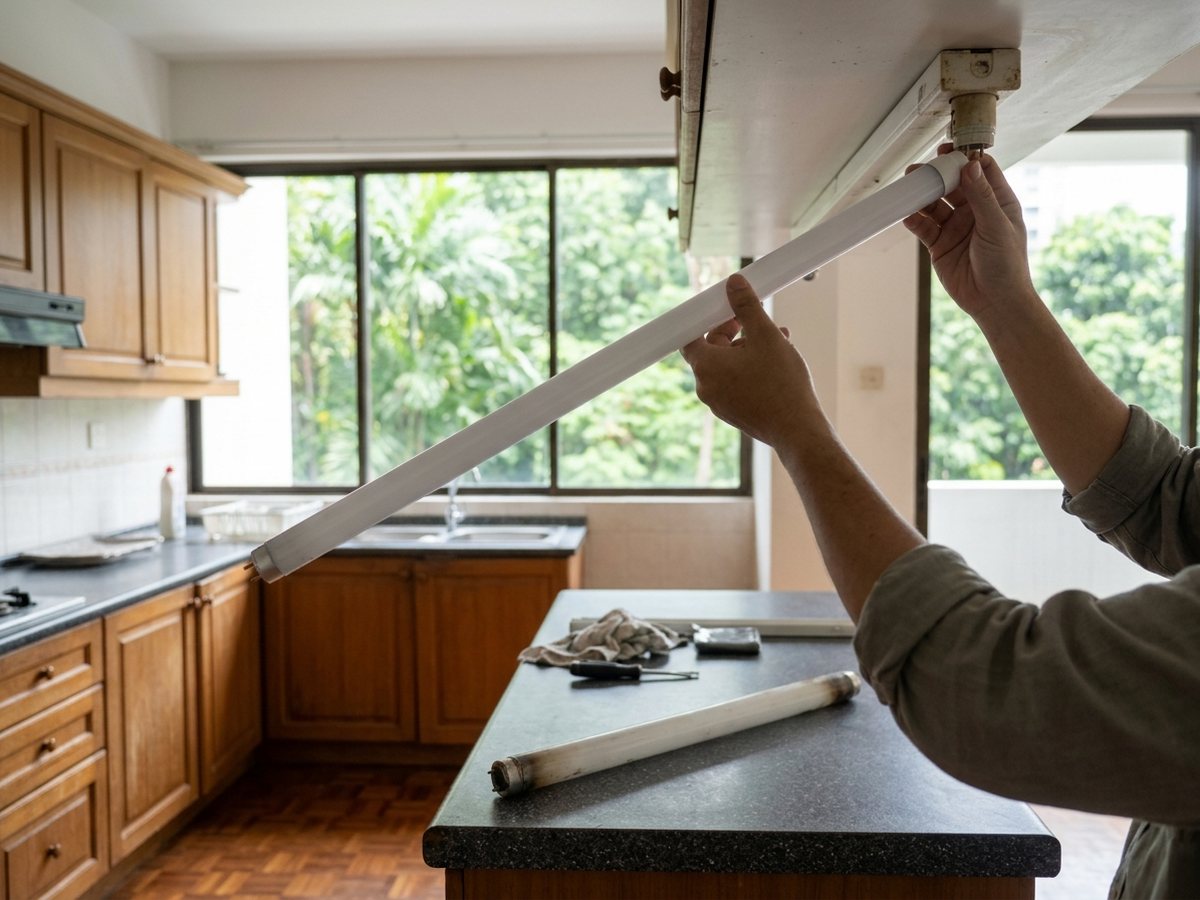
Fluorescent fittings in older kitchens and corridors
The houses of Bangsar Park and Bangsar Baru date to about 1970 and the years after, and the first condominiums on Jalan Ara and Jalan Maarof to the mid-1980s. Homes of that period were commonly lit by fluorescent battens fixed straight to the ceiling, above all in kitchens, corridors, stairwells and car porches.
Such a fitting has three parts that age: the tube, the starter, and the ballast inside the metal body. A flicker at switch-on usually points to the tube or the starter. A steady hum usually comes out of a magnetic ballast, and no new tube will quieten it.
Tube only, or a new fitting
LED tubes are made for the same lampholders as the fluorescent tubes they replace, but they are not all connected in the same way. Some are designed to run with the existing magnetic ballast once the starter is exchanged for the link supplied in the box. Others require mains voltage at the lampholders, which means altering the wiring inside the fitting. That alteration is wiring work, and the reply says so where the tube you have chosen calls for it.
| Tube-only change | New LED fitting | |
|---|---|---|
| What is kept | The metal body, the lampholders and, with some tubes, the ballast | The ceiling point alone, and the fixing holes where they happen to line up |
| Suits | A sound body with firm lampholders and no hum | A fitting that hums, or has brittle lampholders, rust or a yellowed cover |
| What may complicate it | A tube that does not match the ballast; an old ballast left in circuit, which may fail later | Fixing holes in new positions, which means drilling; a mark on the ceiling where the longer body sat |
| Result | The same appearance with lower consumption | A slimmer fitting with none of the old gear inside |
In a strata building, drilling fresh holes in a concrete ceiling is noisy work, and many management offices keep it to set hours on working days. Check with yours before a day is fixed.
Downlights in later plaster ceilings
In an older Bangsar home, a plaster ceiling with recessed downlights was usually added in a later renovation. In the newer towers it is commonly original. In both, three dimensions govern a change of downlight.
The first is the cut-out, the diameter of the hole in the plaster: a new fitting must be wide enough to cover it, and its spring clips must grip the edge. The second is the depth of the space above the ceiling, since the fitting and its driver have to sit there without pressing on anything. The third is the opening itself, through which the driver must pass on its way up.
Earlier downlights were of several kinds: some take a screw-in lamp, some a small halogen lamp fed by a transformer. Where the holder is sound, a change of lamp may be all that is needed. Where a halogen transformer remains in the circuit, an LED lamp may flicker or fail to light, and exchanging the whole downlight for one with its own driver is usually the surer course.
Settle the colour of the light before buying. Warm white, cool white and daylight look markedly different, and one replacement in the wrong colour stands out in a row of six.
Pendant and wall lights at existing points
A pendant or a wall light is hung where a wired point already exists. The point supplies the power; it does not carry the weight. Plasterboard holds very little, so a pendant of any substance is fixed to the slab or to a proper support above the plaster, and the fixing is chosen by the weight stated on the box. A metal-bodied fitting usually has to be earthed, unless it is marked as double-insulated, so the point is checked for an earth conductor before such a fitting is hung.
A light where there is no point, or a point moved along the wall, needs new wiring, and that is identified before any quote. Wiring work is regulated in Malaysia, where Suruhanjaya Tenaga is the body with which electrical contractors and competent persons register, and you may ask who will attend to the wiring side of your job and what registration they hold. In a strata building, cutting a channel in a wall is likely to count as renovation work, for which the statutory by-laws require the management's written approval beforehand.
A house has lights out of doors as well: beneath the car porch, on the gate posts, along a garden wall. A fitting exposed to the weather has to be one made for outdoor use, and its box says whether it is. In an office or a shop the usual fittings are tubes and flat panels set in a grid ceiling, which are taken up under small jobs for offices and shops.
What to send, and what to decide
- A photograph of the fitting, and one of the whole ceiling so that its height and material can be judged.
- For a fluorescent fitting: the length of the tube, and whether the fault is a flicker, a hum, dark ends or no light at all.
- For downlights: how many there are, the diameter of one opening if you can measure it, and whether a dimmer controls them.
- For a pendant or wall light: the box or product listing, with its weight.
- The colour of light you prefer, and whether you will supply the fittings yourself.
- The building and the floor, or the road if it is a house.
How the visit goes
The circuit is made safe
Power to the lighting circuit is switched off and confirmed to be off at the fitting before anything is opened.
The point is examined
With the old fitting down, the cable ends and the fixing are compared with what the photographs suggested. If the insulation is brittle or the point is not what it appeared to be, work stops and you are told what has been found.
The fitting is changed
The tube, the fitting or the downlight is fitted as agreed, with a cut-out adjusted only where that was part of the quote.
Each light is tried
Every lamp is switched on with you present. Old fluorescent tubes contain a little mercury, so they are carried out whole.
What moves the cost
The cost is moved by the number of fittings, the height of the ceiling and what must be shifted to reach it, whether the old fixing holes and cut-outs can be reused, whether the wiring inside a fitting has to be altered, and who supplies the lamps. A quote follows the photographs.
Where a fan shares the ceiling, see also exchanging a ceiling fan.
Questions about lights
Fluorescent tubes to LED: does the fitting need replacing or only the tube?
Only the tube, where the body is sound, the lampholders grip firmly and the LED tube chosen matches the ballast inside. The fitting is better replaced when it hums, when the lampholders have turned brittle with heat, or when the tube you have bought requires the ballast to be taken out of circuit. A photograph of the fitting with its cover off, and of the label on the new tube, usually settles the matter.
Can LED downlights go on the dimmer that is already on the wall?
Not reliably. A dimmer made for filament or halogen lamps was designed for a far heavier load than a few LED downlights present, and the usual signs of a mismatch are flicker, a buzz, or lamps that glow faintly when switched off. The downlights must themselves be marked as dimmable, and the dimmer may have to be exchanged for one suited to LED. That is work at the switch, so it is named in the quote.
Our terrace house has a light high over the stairwell. Can it still be changed?
Usually, but the access decides the method. A stairwell fitting in a two-storey house may hang well above the reach of a domestic ladder, and the stairs beneath make a level footing difficult. Send one photograph taken at the foot of the stairs and another at the landing, so that the height can be judged and suitable equipment brought. Where safe access cannot be arranged inside the house, you will be told so plainly.