
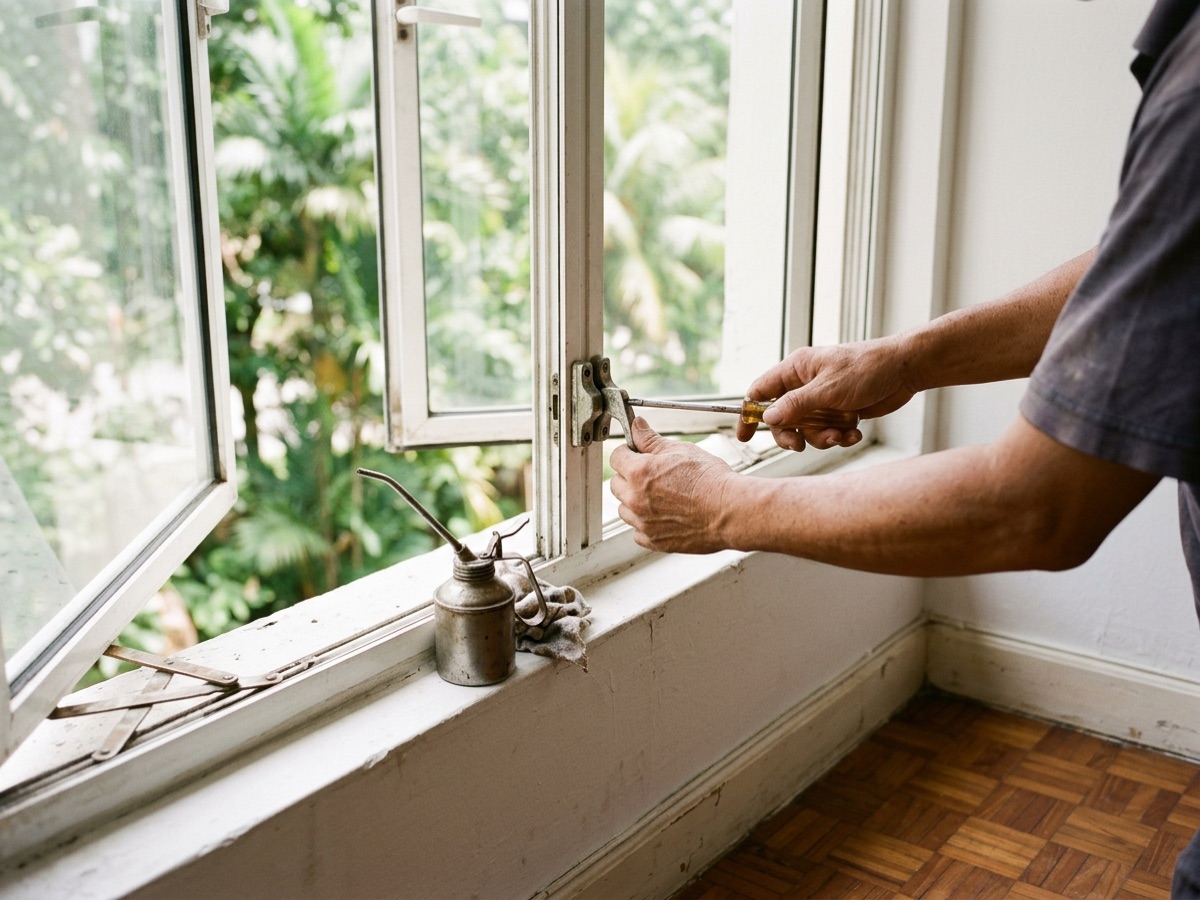
The fittings that are worked every day
A balcony door is slid open and shut, and a window swung out and drawn in, every day for decades. In the condominiums built along and off Jalan Maarof from the mid-1980s onwards, a balcony is commonly reached through an aluminium sliding door, and windows that slide or swing outwards on metal stays are usual. A house has the same fittings at its patio door and its windows, and its front door meets the weather besides.
Sliding doors and windows that drag
A sliding panel does not rest on its frame. It rides on small rollers set into its bottom edge, and these run along a raised track. Two things make such a panel heavy. Grit collects in the track, and the rollers wear or seize. The first is a matter of cleaning, and the track is cleared before anything else is judged.
Many rollers have an adjusting screw, which raises or lowers one corner of the panel. A panel that scrapes at one end, or whose catch no longer meets its keep, can often be corrected with a few turns.
A worn roller is exchanged, and the new one has to match the profile of the frame, because a roller made for one frame seldom fits another. The exchange usually means lifting the panel out.
Casement windows: stays and window handle replacement
A casement window is carried on a pair of stays, hinged metal arms that fold flat as it closes. Their stiffness is what holds the window wherever it is left. As they wear, the window drops at its outer corner, drifts in a breeze, or fails to pull tight against its frame when closed. Stays are exchanged as a pair, like for like, according to their length.
A handle that turns without fastening is usually loose on its screws or worn where it grips the keep. It is tightened, or exchanged for one whose fixing holes match and which is handed for the same side.
A window that can be worked on only from outside, above the ground floor, is declined.
What you notice, and where the fault usually lies
| What is noticed | Where it usually lies | The remedy |
|---|---|---|
| A sliding door is heavy along its whole travel | Grit in the track, or worn rollers | The track is cleared; the rollers are regulated, or new ones matched to the frame |
| A sliding panel scrapes at one end, or its catch misses | The panel sits unevenly on its rollers | Height corrected at the adjusting screws |
| A casement drops, or will not pull tight | The stays have lost their grip | Stays exchanged as a pair |
| A door slams, or stops short of its latch | The closer is out of adjustment, or has lost oil | Valves regulated, or the closer replaced |
| A key is stiff, or a lever fails to spring back | A worn cylinder or lock case | Lockset exchanged by measurement |
Door closers
A door closer is a spring restrained by oil. The spring shuts the door and the oil, passing through small valves, governs the speed at which it does so. A door that slams, or one that creeps to within a hand's breadth of the frame and stops, can usually be regulated without any new part.
Oil on the body of the closer, or on the floor beneath it, tells a different story. The seal has failed, and a leaking closer is replaced.
Door lock replacement, by measurement
A lockset is exchanged like for like, and what makes it alike is its measurements, not its appearance. Two govern: the backset, which is how far the centre of the handle stands in from the edge of the door, and how thick the door is. A new set that differs in either leaves old holes exposed or calls for fresh cutting in the door.
A digital lock that you have bought may be fitted where the door suits it, which depends on the thickness of the door and on the cut-outs left by the old lock. Where the door is the entrance door of a strata home, the question in the next section is put to the management before anything is fitted. Where the key is lost and the door is shut, a locksmith is needed; opening locked doors is no part of this work.
The doors of a house
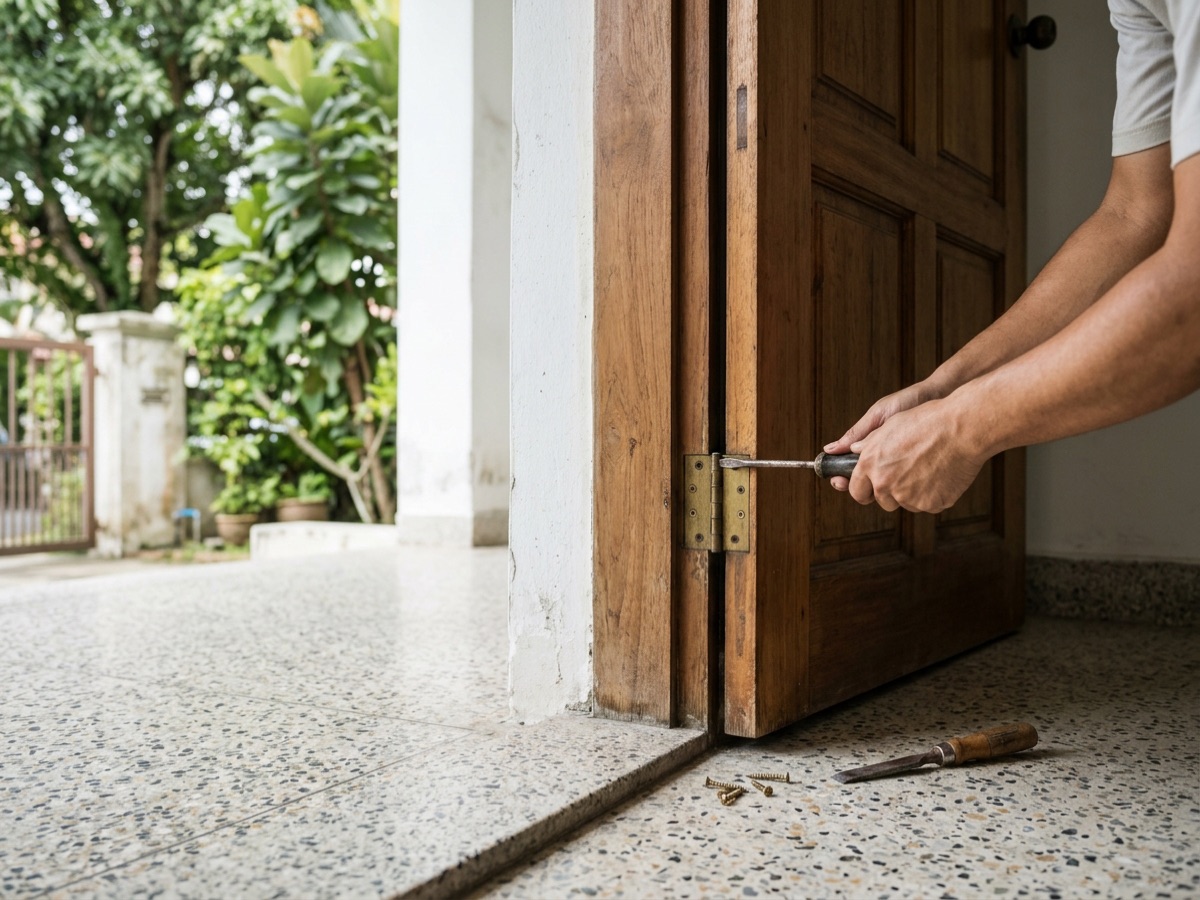
At a house the front and back doors meet the weather. A timber door or frame that takes the rain or the afternoon sun swells, and over the years it drops on its hinges. The remedy begins at the hinges before any wood is removed, as explained under locks, bells and odd jobs. A grille or a gate that needs cutting or welding is a metalworker's task, and the motor of an automatic gate has a trade of its own.
The entrance door of a strata home
The entrance door of a unit in a strata building is often a fire-rated door, and the outer face of the windows and balcony doors forms part of the building's appearance. For both reasons, ask the management before the entrance door, its lock or its closer is changed, and before anything visible from outside is altered. Put the question early, in an older Bangsar block as in the station towers of KL Sentral and Brickfields.
What is not undertaken
Glass is not replaced, new door or window frames are not supplied, and metal grilles are neither made nor welded.
What to send, and what moves the cost
- A line on what the door or window does, and when it began.
- A photograph of the moving part: the foot of a sliding panel and its track, the stays of a casement, the body of a closer, or the edge of a door.
- The building and the floor, or the road if it is a house.
The cost depends on whether the fault is cured by adjustment or needs a part, whether a matching part can be found, the size of any panel that must be lifted out, and the number of doors and windows on the list. A quote follows the photographs. Where a new lockset or closer leaves the outline of the old one in the paint, see painting and touch-up.
Questions about doors and windows
The front door slams however gently it is released. Can the closer be adjusted, or must it be changed?
Usually it can be adjusted. The closing speed is set by small valves in the body of the closer, and a turn of the right one slows the door. Look first for oil on the body or on the floor beneath, because a closer that has leaked cannot be regulated and is replaced. On the entrance door of a strata home, ask the management before a closer is changed.
May a digital lock I have bought be fitted to my front door?
Often it may. Whether it can depends on the thickness of the door and on the cut-outs left by the present lock, which the new one has to cover. In a strata building the entrance door is often fire-rated, so ask the management before anything is changed. Send the model of the lock with photographs of both faces of the door and of its edge.
A window lets in rain during a storm although it is shut. Are the stays to blame?
They may be. A worn stay lets the casement sit slightly off its frame at one corner, and wind-driven rain finds the gap. Close the window, look along its edges from inside, and photograph any corner that stands proud. If the window closes evenly all round and water still enters, the fault lies elsewhere, often in the seal on the outer face, and the outside of the building is usually the management's to inspect.