
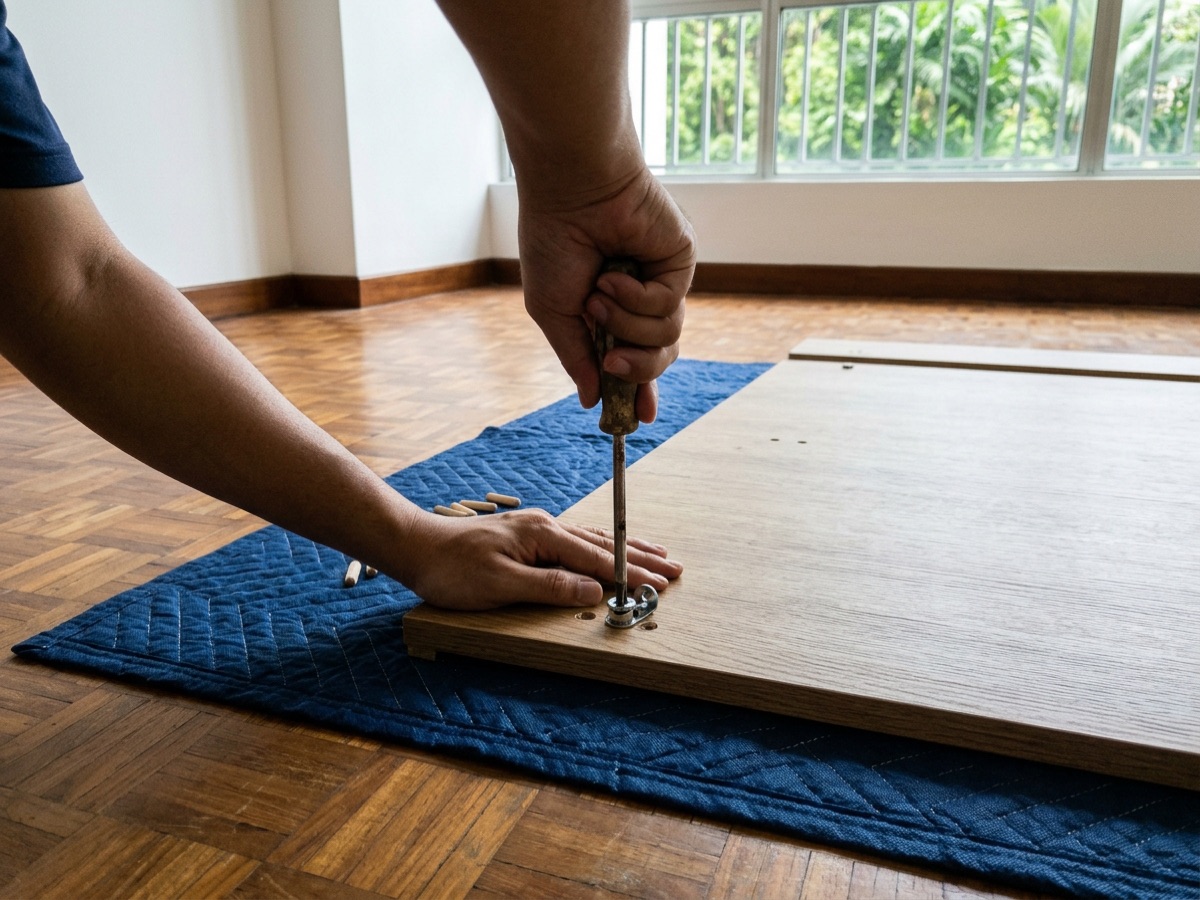
Boards, a bag of fittings and a room
Flat-pack furniture arrives as a stack of boards and a bag of fittings, whether it comes from IKEA or from any other shop, and the building of it is left to the buyer. In Bangsar three kinds of household are likely to face that task: an owner in a house or a condominium of some age furnishing a room afresh, a tenant in one of the later towers with a bed and a desk still in their cartons, and a household moving between addresses whose wardrobe has to come apart before it can leave the bedroom.
Flat-pack wardrobe assembly: why the piece is built where it will stand
A wardrobe is a large box, and once it has become a box it will not bend. An assembled carcass frequently cannot be taken through a bedroom doorway, round the turn of a staircase in a two-storey house on the landed streets of Bangsar Baru, or into the car of a lift. It is therefore built in the room it is meant for, and in a house the cartons are carried up the stairs unopened.
Height has to be considered as well. Wardrobes are commonly put together lying on the floor and then stood upright, and as the piece is raised its top corner swings up higher than the piece will finally stand. The ceiling must clear the diagonal of the side panel, not merely its height. Where it does not, the wardrobe is built standing, which is slower work.
The count that comes before the first joint
An assembly begins with a count. Every board and every fitting is checked against the list in the instructions before two parts are joined, because a missing fitting or a damaged panel discovered halfway leaves a half-built piece occupying the room until the shop supplies the part.
The joints in furniture of this kind are mostly dowels and cam locks. The dowel locates one board against another, and the cam, given part of a turn, draws the two tight. The maker's order of assembly is followed for a practical reason: a back panel that should have been slid in early, or a shelf fixed before its neighbour, can mean taking apart what has just been put together.
Floors that are not level, and skirtings
Older floors are seldom flat from one wall to the other. Parquet laid decades ago has usually moved a little, and a tiled floor is not always level from one side of a room to the other. A tall piece standing on such a floor leans with it, and the first sign is a pair of doors that hang out of line and will not close evenly. The remedy is found at the foot of the piece. Adjustable feet are wound up or down, or thin packers are set beneath the low side, until the carcass stands square and the doors meet.
A timber skirting holds the foot of the piece away from the wall and leaves a gap behind it higher up. The restraint that ties the piece to the wall has to bridge that gap, and is usually packed out so that the fixing is not pulled askew. Parquet deserves a precaution of its own: the boards are laid on a blanket or on the flattened cartons while they are worked on, since a panel edge dragged across timber marks it.
Securing a tall piece to plastered brick
Tall, narrow furniture can tip forward when a loaded drawer is pulled out or a child climbs a shelf, and makers usually supply a restraint for that reason. The restraint is only as good as its hold in the wall, so the wall is assessed as it would be for any other fixing. Plastered brick, which is common in the older blocks and houses here, needs a plug long enough to pass through the plaster and seat in the brick, because plaster alone crumbles under a pull.
In a strata building the by-law on drilling applies to this small hole as it does to a large one. No drilling or screw-fixing is permitted within 300 mm of concealed pipes and conduits. The reasoning for each kind of wall is given under mounting and curtain rails.
Taking a piece apart for a move
Chipboard grips a screw less firmly each time the screw is withdrawn. A piece that has been moved several times may therefore need its joints re-seated before it stands as firmly as it did.
When a wardrobe is dismantled, the fittings are bagged and the boards marked panel by panel, so that it can be re-assembled at the other address without the booklet. A bed or a table that has merely worked loose is a lesser matter: its joints are tightened in turn, and a fitting that has failed is exchanged for one that matches. A loose hinge on a kitchen cabinet belongs under locks, bells and odd jobs.
How a furniture assembly visit is arranged
The pieces and the room
Say what each piece is and how many there are, with the maker and model where you know them. Add the ceiling height, the kind of floor, and whether the home is reached by a lift or by stairs.
Assessment
The reply states how each piece would be built, and what securing it to the wall involves.
The appointment
A time is fixed between 9.00 am and 6.00 pm, Monday to Saturday, to suit you and, in a strata building, the management's requirements for workmen and for drilling.
Assembly and packaging
The piece is built, levelled and secured. In a strata building, where the cardboard goes afterwards is governed by the building's rule for bulky waste; at a house, say where you would like it left.
What moves the cost
The cost of furniture assembly follows the number of pieces and their size, how many doors and drawers each carries, whether a piece must be built upright, whether it is to be secured to the wall, and whether anything has to be dismantled first. A quote follows the description. For desks and cabinets at a workplace, see small jobs for offices and shops. A tenant fitting out a new home in a recent tower, as in Bangsar South, may well add mirrors and curtain tracks to the same list.
Questions about furniture assembly
Will a tall wardrobe go in beneath the ceiling of an older flat?
That depends on how it has to be built. Assembled on the floor and then raised, a wardrobe needs a ceiling higher than the diagonal of its side panel, which is always somewhat more than its height. Send the ceiling height together with the height and depth of the finished piece, as given in the instructions or the shop's listing. Where the figures are too close, the piece is built upright in its place, provided the maker's design allows it.
Can a wardrobe that has been dismantled once be put together soundly again?
Usually it can, with one reservation. Chipboard holds a screw less well each time, so joints that have slackened are re-seated, and a cam or dowel that has broken is exchanged for a matching one. A panel that has split around a fitting may not hold a second time. Photographs of the boards, laid flat with their edges showing, allow a fair opinion before the visit.
Should the cartons be opened before the visit?
There is no need, and it is better that they are not. Leave them sealed and lying flat in the room where the piece is to stand. The count of boards and fittings is made at the start of the visit, with everything in one place. If a carton arrived torn or crushed, open that one and mention what you find.