
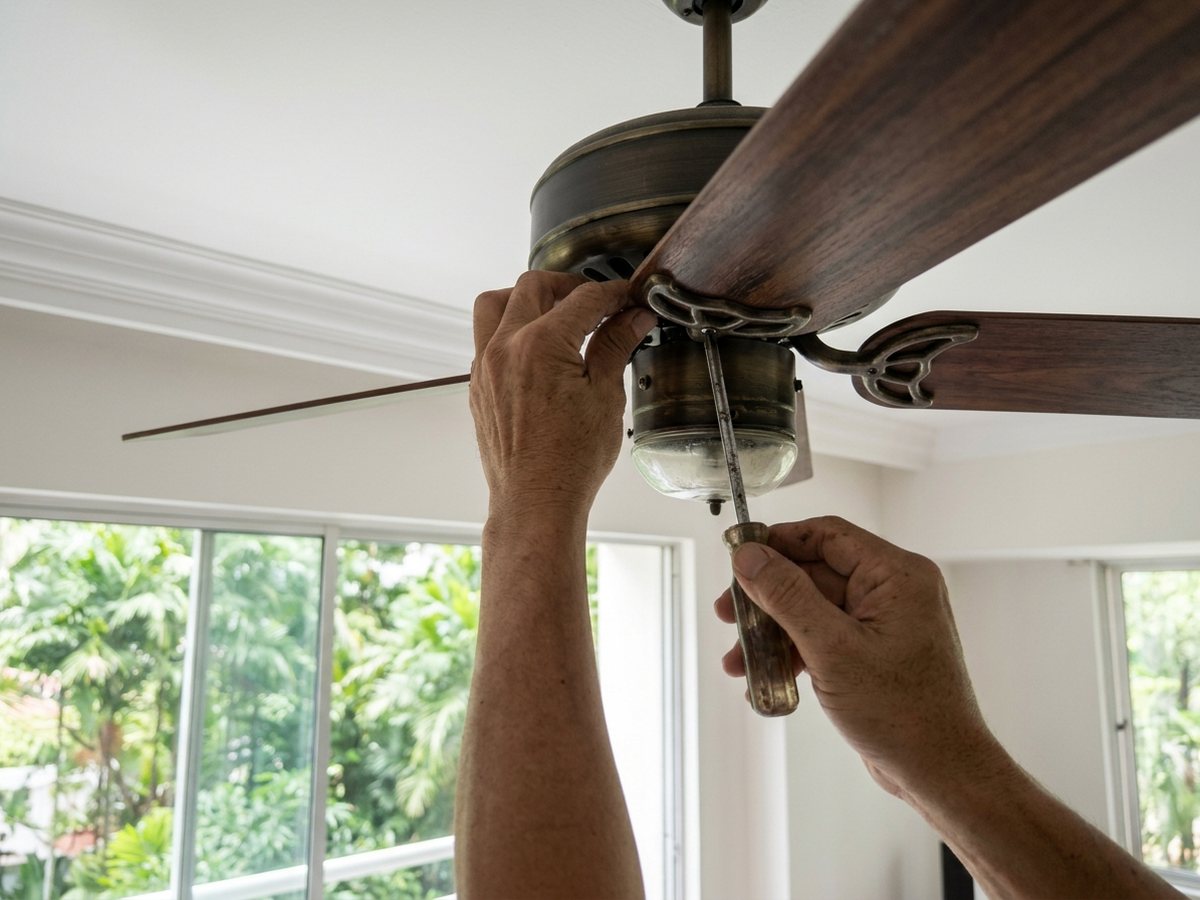
Exchanging a fan in an older home
A ceiling fan is among the longest-serving fittings in a home. In Bangsar's landed streets of the 1970s, and in the condominiums that followed in the mid-1980s and after, it is not unusual to find one that was turning before the present owner arrived. When it is finally exchanged, the new fan seldom matches the old in three respects: how it hangs, how it is controlled, and whether it carries a light.
The hook or fixing in the slab
A fan of the traditional pattern hangs by a rod on a steel hook set in the concrete slab. The hook is the one part that would be reused without having been looked at since the day it was cast in, so it is examined first: for rust, for wear where the hanger bears on it, and for any movement in the concrete around it.
Many newer fans do not use a hook. They hang on a bracket fastened to the slab with anchor bolts, and that means drilling. In a strata building the statutory by-laws forbid drilling within 300 mm of concealed pipes and conduits, and the conduit that feeds a fan point usually runs in that same slab. The by-law asks for more than a guess at that route: it is to be found with a detector, and checked against the as-built plans at the management office, before the drill is used. Where the fixing cannot be kept clear, the management is asked before any hole is made.
Where a plaster ceiling hangs below the slab, the fan is still held by the slab or by a proper support above the plaster, never by the plasterboard, which carries very little. The upper rooms of a terrace house may have no slab overhead, only a ceiling board beneath the roof timbers, and there the fan must hang on a structural member, while the board itself, which can be brittle with age, is disturbed as little as possible. A photograph cannot always show which it is, and an inspection is then proposed.
The regulator or the remote
Older fans are controlled by a regulator on the wall, a dial with several speeds. Many current fans, those with DC motors among them, are controlled by a handset and a receiver housed in the canopy. A fan of that kind expects a plain, full supply and is generally not to be run through an old regulator. The regulator has then to be taken out of the circuit and a switch put in its place. That is wiring work at the switch position, and it is stated in the quote when the fan you have chosen requires it.
Wiring work is regulated in Malaysia, where Suruhanjaya Tenaga is the body with which electrical contractors and competent persons register. Do ask who will attend to the wiring side of the exchange and what registration they hold. If the photographs show that an additional point, a separate circuit or attention at the distribution board would be needed, the reply says so before any quote.
A fan with a light kit
A fan that carries a light places two loads on a point that was wired for one. How that is managed depends on the control, and the first question below deals with it. The position matters too: a lamp fixed above the blade path throws a moving shadow, so nearby light fittings and downlights are considered together with the fan.
Finding a wobble or a hum before buying
A fan that misbehaves is not necessarily finished. Several faults lie in parts that can be tightened, balanced or exchanged, and it is worth having them traced before a new fan is ordered.
| What you notice | Likely cause | What usually settles it |
|---|---|---|
| A wobble that grows with speed | Loose blade screws, a bent blade arm, or blades of unequal weight; timber blades can warp | Tightening, truing the arms or adding balance weights; a warped set is replaced |
| The whole fan sways on its rod | Wear at the hook or hanger, or a loose pin in the rod | Examination at the ceiling, and new hanging parts where they can be obtained |
| A hum at low speed | Often the regulator, not the motor | A regulator suited to the fan, which is work at the wall control |
| Slow to start, or slow at every setting | Often a failing capacitor | A capacitor of the same rating, if the motor is otherwise sound |
| Rubbing or grinding | Worn bearings | Usually a new fan |
For all but the last row, a short video of the fan running, with the sound on, tells a good deal.
What to decide before buying
- The sweep of the blades in relation to the room, with clearance to walls, wardrobes and the tops of doors.
- The height of the ceiling. Manufacturers state a minimum distance between blades and floor, and a low ceiling may call for a short rod or a close-mounted fan.
- Hook or bracket: what the new fan needs, and what your ceiling offers.
- Regulator or remote, and whether you are content for the wall control to change.
- With a light or without, and where the existing lights are.
- What becomes of the old fan: taken away, or left with you.
How the exchange is carried out
Assessment
Photographs of the ceiling and the wall control are set against the listing for the new fan, and anything that does not match is raised before the visit.
The old fan comes down
Power is switched off, the blades are removed first and the motor is lowered. The hook or fixing is then examined with nothing hanging on it.
The new fan is hung
It goes on the hook, or on a bracket anchored to the slab or to the support above a board ceiling, once the position has been checked.
Connection and control
The fan is connected at the point, and the wall control is dealt with as the quote described.
Balance and trial
The blades are fitted, the safety wire is attached where the maker supplies one, and the fan is run at every speed with you present.
What moves the cost
The cost of an exchange is moved by the fixing more than by the fan. Reusing a sound hook is the least work; anchoring a bracket to the slab is more, and finding a support above a ceiling board is more again. The height of the ceiling, a change of regulator, the assembly a particular fan requires and the removal of the old one all count as well. A quote follows the photographs.
In a condominium, drilling the slab is noisy. Many management offices keep such work to set hours on working days and wish to know who is entering the building, so check with yours and the visit is planned around the answer. Wall fans are fitted as well; the wall is treated as the page on fixing into brick, concrete and tile describes.
Questions about ceiling fans
Can a ceiling fan with a light kit run from one switch?
It can where the fan is controlled by a remote. The wall switch then simply supplies the fan, and the handset operates the motor and the light separately. A fan whose light is meant to be switched at the wall is a different case: it needs a second switched conductor between wall and ceiling, which an older fan point seldom has. Running one is new wiring, and it is identified before any quote.
The old fan hangs on a hook. Will a new fan fit the same hook?
That depends on the fan more than on the hook. Fans of the traditional pattern, with a rod and hanger, are made for a hook and will usually suit one that is sound. Fans supplied with a ceiling bracket are generally meant to be bolted to the slab instead. Send the product listing with a photograph of the present fan where it meets the ceiling, and you will be told which applies before you buy.
Is a wobbling fan worth repairing, or should it simply be replaced?
A wobble alone is seldom a reason to replace. It usually lies in the blades, their arms or the hanging parts, all of which can be tightened, trued or balanced. Replacement becomes the better course when the bearings grind, when parts for an old model can no longer be obtained, or when the blades have warped beyond balancing. A short video of the fan at full speed helps to tell these cases apart.